_
Lad os arbejde sammen
Nibelungen Bridge
CLIENT
MKP
INDUSTRY
Offentlig Virksomhed
EXPERTISES
Digital Twins & Innovation Tech
CREDITS
En kompakt digital tvilling af den store og historiske Nibelungenbro over Rhinen. Som en del af den europæiske forskningsinitiativer SPP100+ blev en historisk brostruktur - der er udvidet flere gange og delvist ødelagt i løbet af sin levetid - undersøgt som et pilotprojekt. I stedet for at kortlægge hele strukturen digitalt fra starten, fokuserede projektet bevidst på et klart defineret pilotområde. Denne mindre digitale tvilling gjorde det muligt at demonstrere det overordnede system på en praktisk og håndterbar måde.
PROJECT OVERVIEW
Challenge
Outcome
Architecture
Functionality
Approach
_
Why Start with a Pilot Area?
Like people, buildings and bridges tend to age disproportionately over time. As structures grow older, infrastructure management becomes more demanding, more complex, and more costly.
A digital twin offers a better way to meet this challenge - making data easier to access, understand, and use in a targeted way.

_
A Scalable Framework for Digital Twins
All project data was linked directly to the structure and organized in a consistent way. The framework developed up to that point was successfully tested both in the rollout of digital twins and in its transfer to other structures.
Compared with the first digital twin created for this client, the time needed to build this new digital twin was reduced to just 13.3%. The previously developed Digital Twin Core Framework could be transferred directly to the new project.
This showed that once a solid framework is in place, digital twin development can become significantly faster and more scalable.

_
Extending the Framework
The framework was further enhanced with prototype functions for new types of object linking.
In addition to Point of Interest and Structure of Interest functions - such as drilling down into 3D building components - the project also tested an Area of Interest approach.
This allowed the client to define and visualize spatial relationships independently of the original BIM planning. In other words, relevant areas could be selected and displayed based on actual use cases, not just predefined model logic.
Geometries remain hidden until selected, allowing users to focus only on the information that matters in the moment.
By embedding these areas in the data model and transferring them in a separate IFC file, spatial zones could be defined independently from the original model and enhanced with their own visualization functions.

_
Exploring Data in the Model
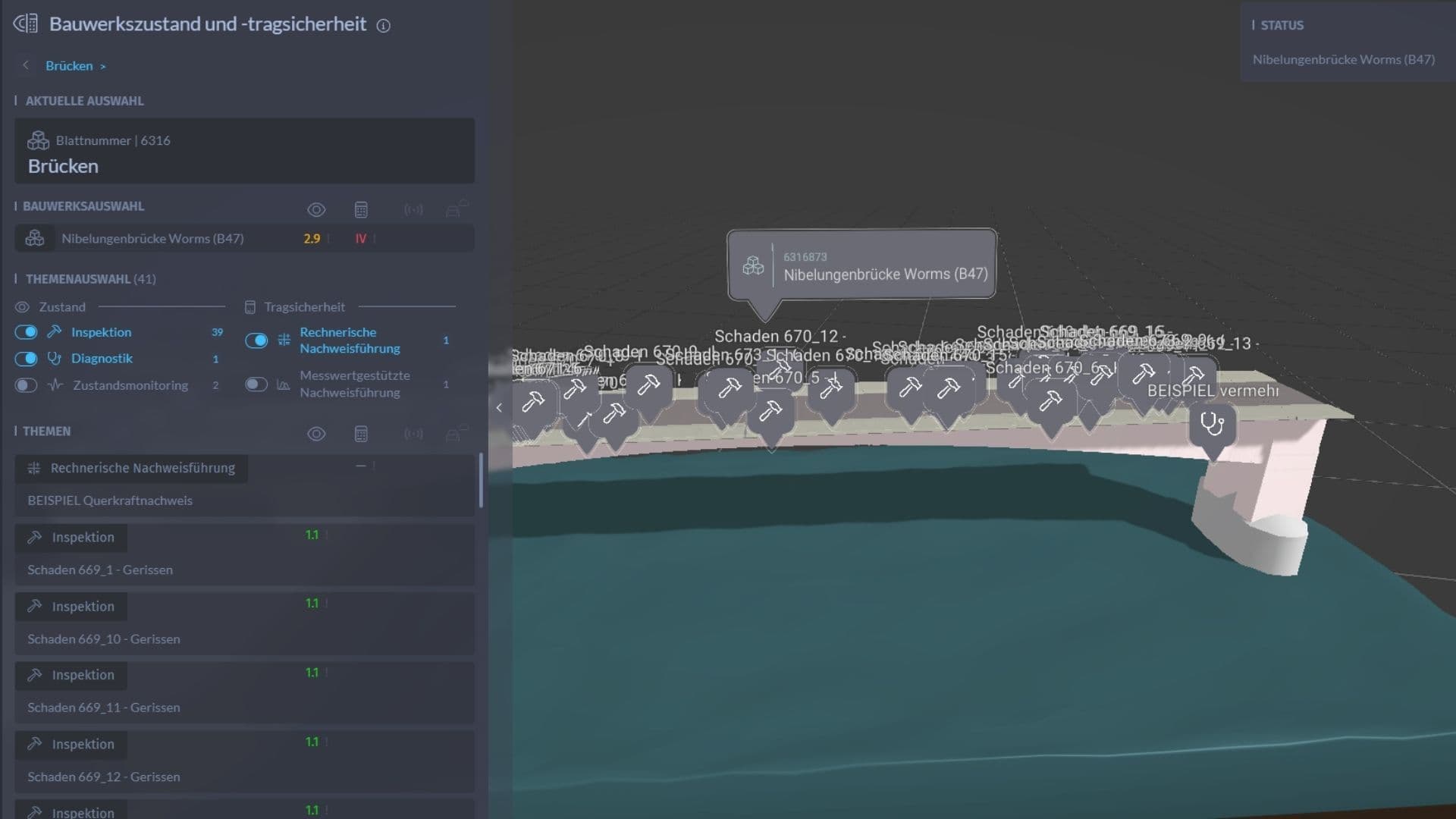
The model environment combines a BIM or CDE viewer with the Digital Twin Core Framework and a simplified surrounding context model.
A topic filter allows users to choose which data sources they want to display with just a few clicks. This makes it easy to switch between different information layers and focus on what is relevant.
For one selected spatial model area, 41 datasets are currently available across the chosen topics.
A Point of Interest can show location-based information such as current traffic or weather data. Markers in the model indicate where information is available. If data exists, it becomes visible. If no data exists, nothing is shown.
This creates a simple and intuitive form of data-driven visualization.

_
Start with the Right Scope
A successful digital twin project does not have to begin at full scale. Starting with a clearly defined area can be the smartest way to create value quickly, test workflows, and build a scalable foundation for future development.
Kontakt
Er du nysgerrig på, om det er det rette match?

Er du nysgerrig på, om det er det rette match?