Connecting Construction & Operations
Client
DB InfraGo – Hamburg Central Station
Industry
Infrastructure
Expertise
Digital Exploration & Digital Twins
Process & Operations Design
About
Digital Exploration & Digital Twins Process & Operations Design
Visit dbinfrago.com
Overview
Introduction
The Challenge
The Collaboration
The Approach
The Architecture
The Solution
The Functionality
The Results
_
At Hamburg Central Station, numerous stakeholders and organizations work in parallel, from construction teams to station management, facility management, and retail space management. Cross-project model and data management required optimization to improve communication among these stakeholders and provide clear, easy access to up-to-date information. The goal was to develop concrete and realistic solutions for technical implementation, resulting in improved collaboration.

_
Many Processes, Many Systems, Many Data Silos
Different systems are used to manage data for different processes, and it is generally more practical for individual teams to organize themselves in a focused manner within their own storage system. Most Common Data Environments (CDEs) typically focus on individual projects within the construction planning process. Archives, such as as-built plans, have multiple decentralized sources and are not accessible to all stakeholders. Other subprocesses related to building operations involve additional data sources that cannot easily be assigned to traditional construction operations.
Due to the large number of stakeholders and other organizations in the metropolitan area, data silos inevitably arise. Previous attempts to manually or semi-automatically consolidate these relationships within a single system using metadata had failed. Furthermore, it was not possible to permanently provide all employees with all paid licenses for viewers or license-required CDEs.
_
Interdisciplinary Collaboration Across Departmental Boundaries
The project was the result of an interdisciplinary collaboration: a project team including the on-site Construction Management, a specialized BIM Consulting, and Kruso in the role of Digital Consulting worked hand in hand. Station Management and its various departments, such as Facility Management, Property Management, and Operations, were also involved. The approach resulted in a high level of acceptance overall.
_
From the Discovery Workshop to a Data-Driven Prototype
The project began with ideation and discovery workshops, as well as interviews with representatives from various departments. Based on this, the key user stories were defined, and the existing data sources and system landscape were analyzed.
This was followed by the creation of a prototype featuring data-driven information display and the development of the necessary Application Programming Interfaces (API's) for automated data display. The data model of the business system, which serves as the primary system in many cases, was abstracted and transferred in a simplified form to the Digital Twin’s data model. Exploratory interviews with the business departments were conducted to identify opportunities for optimization and expansion. Upload templates and a story migration process ensured that the existing systems could continue to be maintained and that the new approaches could be implemented within them.
_
A Coordination Model as a Central Data Hub
At the center of the Digital Twin lies the most recent overall coordination model, through which the Digital Twin is linked to the BIM process. Data-driven systems are integrated via multiple import API's and displayed as data layers:
As-built plans and documents from the construction teams' data environment
Live data via APIs
Leading business management system for room IDs, technical data, and other financial data for ongoing operations and rental management.
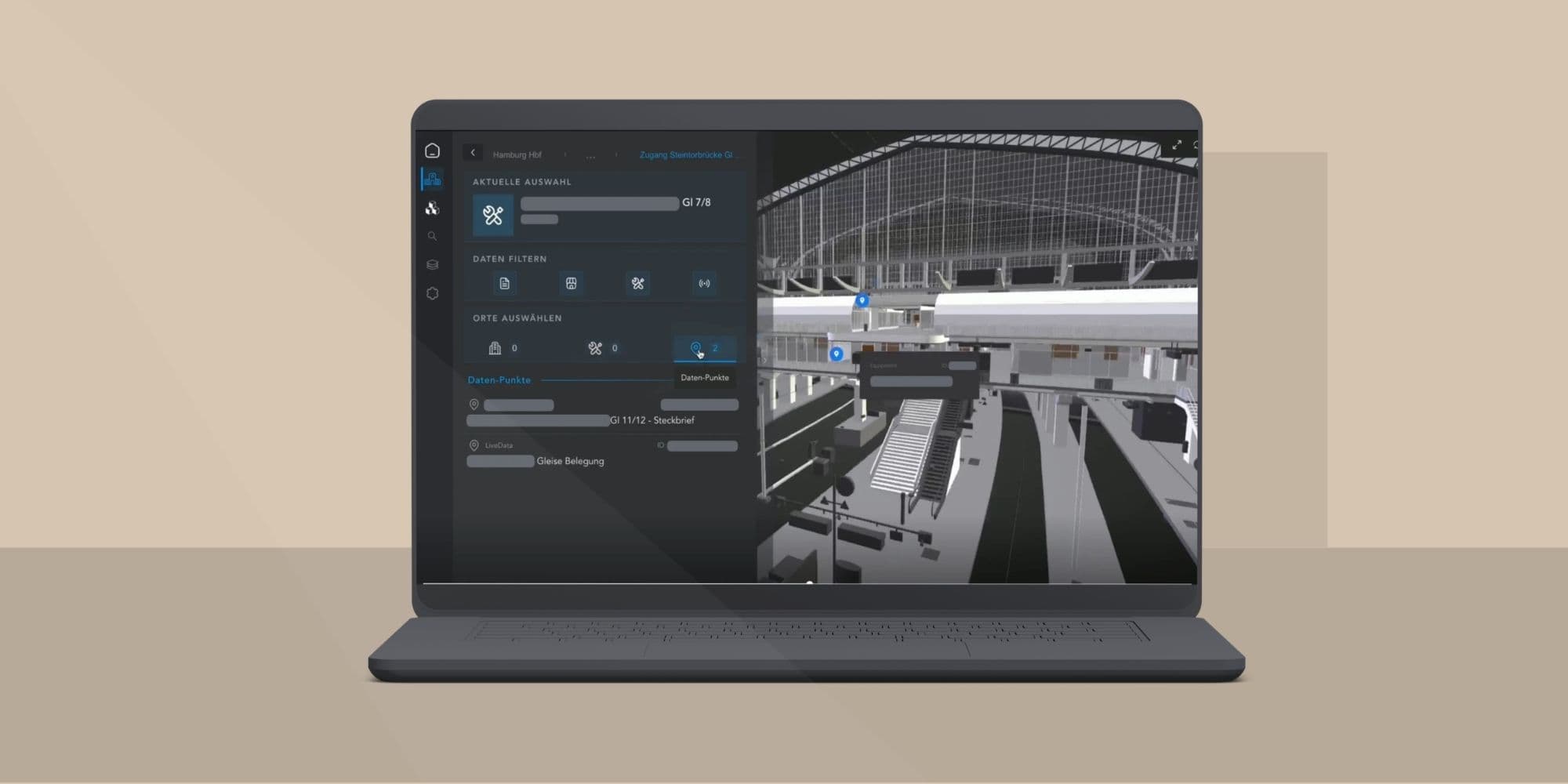
Users can navigate through a hierarchy of locations using both the 2D layer and the 3D model; this means that these are based equally on the model and the data. For each location, users are shown lists and 3D data points from all available datasets associated with that location.

_
A Digital Twin Integrates Construction and Operations
Traditional BIM tools continue to support all construction processes, including planning and implementation. A digital twin connects existing tools and databases and clearly displays their relationships in 3D. At the interface between construction and operations, it consolidates various levels of information within the 3D model and links them visually to better document the status.
The overall coordination model is updated regularly and serves as the basis for cross-project and cross-departmental communication. To ensure that all employees have access to this consolidated view, the prototype demonstrated how an individual Digital Twin Viewer can be created using open-source components. Over time, this viewer may require technical adjustments to accommodate new software components, but it does not incur any licensing fees of its own.
Cross-functional roles and permissions were managed through the access rights of the respective target systems: Anyone who is already authorized to access those systems can log in directly to the respective system from the Digital Twin. The existing target systems will continue to control actual access. The advantage: nearly all employees can gain access to Digital Twin.
For the key user stories of the digital twin, additional details are displayed in the data layer, such as the technical connections for a retail space or the layout of equipment installations. Station employees receive a comprehensive solution that allows them to gain a very concrete understanding of how data storage and digital tools work together and to formulate new requests. The high-priority stories were all implemented, enabling each department to test a use case that was prioritized for them.

_
Different Key User Stories for Each Department
Building on the key user stories developed during the Discovery Workshop, a unified data model was developed to link thematically and technically heterogeneous data types, and the key user functions for operating the system were defined. In this way, the digital twin can display property sets from BIM just as well as commercial or technical data. A filter function allows all departments to filter specific data sources based on their specific needs or context, such as information on platform equipment, a store, or real-time data from rail & train operations.


_
A Validated Prototype as a Common Basis
The result is an advanced prototype with data integration as well as front-end and back-end structures, which all stakeholders can use to validate their requirements regarding collaboration, technical API's and the desired data structure. The high-priority user stories were fully implemented, ensuring that every department could see itself reflected in the new solution.
What all stakeholders had, and still have, in common is that they have little time, as they are fully occupied with operational projects and ensuring business continuity. In this respect, this project also helped increase acceptance of the need to contribute to data provision, as it brought to light a shared desire: there are operational interdependencies between the individual processes and teams, and all stakeholders want greater transparency and a more standardized exchange of information regarding these interdependencies. Until now, key details that affect each person’s own work could not be adequately shared, and this is precisely where the solution steps in.
Markus Meyer-Westphal
Contact

Contact